gapwatch: crash-test how many database changes your app misses when its connection drops
Realtime
Database
CLI
·Python
I built a small open-source CLI to measure something I kept running into with real-time apps: when a connection drops, database changes sent during the gap just disappear, with no error.
gapwatch writes numbered changes to your database, listens the way an app does, cuts the listener's connection on purpose, and reports exactly what never arrived.
I ran it against a free Supabase project from Brazil (database in Ohio, through the Session pooler):
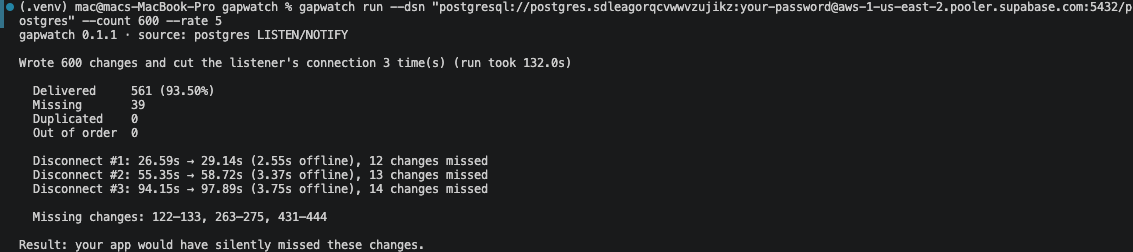
Two things surprised me:
- Reconnecting faster doesn't fix it. Even when the listener was back within ~10 ms locally, it still lost a few changes per disconnect.
- Reconnecting takes longer than the setting says. The listener waited 1 second, but each gap was 2.5 to 3.75 seconds, because opening a new connection across a continent and through the pooler takes time.
To be clear about scope: version 0.1 tests Postgres LISTEN/NOTIFY on a Supabase database, not Supabase Realtime itself. Realtime support is next on the roadmap.
Try it on a test project:
pip install gapwatch gapwatch run --dsn "your Session pooler string" --count 600 --rate 5 gapwatch cleanup --dsn "..."
Use the Session pooler, not the Transaction pooler, which doesn't support LISTEN.
Repo: https://github.com/Dakokodaripon/gapwatch
I'd really like to hear if you'd use a real-time version, and which failure cases matter most to you: reconnects, server restarts, slow networks?
How to help
David introduces 'gapwatch', an open-source CLI tool designed to measure database changes missed when a connection drops. He shares findings from testing it against a Supabase project, noting issues with reconnect speed and connection delays. David seeks feedback on the potential development of a real-time version of the tool and asks which failure cases are most important to users.